
UPI vs Debit vs Credit Cards: Which Payment Method Is Cheapest After MDR Charges?
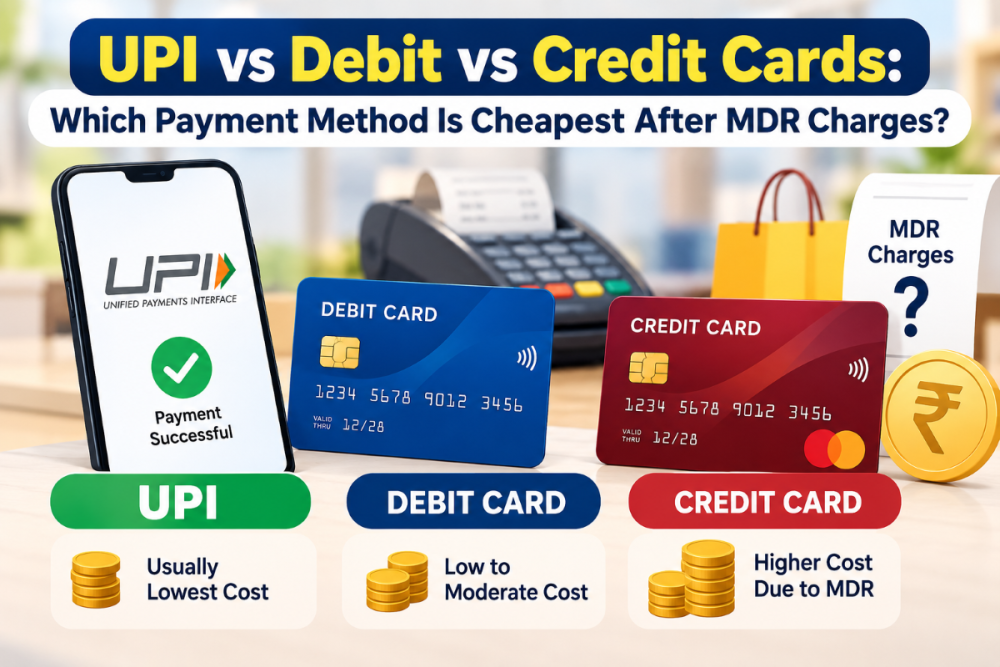
UPI has become a normal part of daily life in India. We use it at grocery stores. We use it for food delivery. We also use it for shopping and paying bills. A simple QR scan can complete a payment within seconds.
But a new UPI MDR rule is bringing an important question. Will UPI still be cheaper than debit cards and credit cards after MDR charges?
From October 15 2026 certain Person to Merchant or P2M UPI payments above ₹2,000 will attract a 0.4% Merchant Discount Rate or MDR. For transactions of ₹75,000 or more the standard MDR is capped at ₹300.
The important point for customers is simple. You do not have to pay this UPI MDR. It is a merchant side charge. So UPI will continue to remain free for normal users under the new system.
What Is MDR in Simple Words?
MDR means Merchant Discount Rate. It is a fee paid by a merchant for accepting certain digital payments.
Suppose you visit an electronics store and buy a smartphone for ₹30,000. You pay ₹30,000 through UPI. If that payment comes under the new MDR rules then the merchant may have to pay the applicable MDR.
You should not be asked to pay an extra 0.4% simply because you selected UPI. The MDR is a merchant side cost. It should not be added as a separate UPI transaction charge for the customer.
How Will the New UPI MDR Work?
The new rules do not mean that every UPI payment will become chargeable. Most normal UPI payments will continue to work in the same way for customers.
Person to Person or P2P transfers will continue to remain free. Merchant payments of up to ₹2,000 will also remain outside the new MDR charge. Qualifying small merchants continue to get zero MDR benefits.
Here is a simple overview:
| UPI Transaction | MDR |
|---|---|
| Person to Person payment | ₹0 |
| Eligible merchant payment up to ₹2,000 | ₹0 |
| Eligible merchant payment above ₹2,000 | 0.4% |
| Eligible payment of ₹75,000 or more | Maximum ₹300 |
| Qualifying small merchant payment | Zero MDR as per applicable rules |
This means your normal UPI experience is unlikely to change much. You can still send money to friends or family without paying MDR.
Real Example: Buying a ₹10,000 Smartphone
Suppose you visit a mobile store and purchase a smartphone for ₹10,000. You decide to pay using UPI.
At 0.4% MDR the merchant side cost would be ₹40.
₹10,000 × 0.4% = ₹40
You still pay ₹10,000. The ₹40 is not supposed to become an extra UPI fee charged to you.
Now suppose the same store accepts a credit card. The merchant processing cost can be higher depending on the card network and merchant agreement. This is one reason UPI can continue to be attractive for Indian businesses even after MDR is introduced.
How Much MDR Will a Merchant Pay?
The amount becomes easier to understand with some simple examples.
| Purchase Amount | UPI MDR at 0.4% | Customer Pays* |
|---|---|---|
| ₹1,500 | ₹0 | ₹1,500 |
| ₹5,000 | ₹20 | ₹5,000 |
| ₹10,000 | ₹40 | ₹10,000 |
| ₹25,000 | ₹100 | ₹25,000 |
| ₹50,000 | ₹200 | ₹50,000 |
| ₹75,000 | ₹300 | ₹75,000 |
| ₹1,00,000 | ₹300 cap | ₹1,00,000 |
*Examples assume the transaction falls under the applicable standard UPI MDR framework and no separate legitimate platform or convenience fee applies.
The ₹300 cap is important for high value payments. Without a cap a ₹1 lakh transaction at 0.4% would produce ₹400 MDR. Under the standard cap the applicable MDR would be limited to ₹300.
Is UPI Still Free for Customers?
Yes. This is probably the most important point for UPI users.
The new MDR is not a normal transaction fee for customers. If you send ₹5,000 to a family member through UPI then it remains a Person to Person transaction and does not attract this MDR.
The situation is different when you pay an eligible merchant. The merchant may have to pay MDR but the customer should not be charged the merchant's UPI MDR as a separate fee.
UPI vs Debit Card: Which Is Cheaper?
Debit cards are also directly connected to your bank account. If you have ₹20,000 in your account and spend ₹5,000 through a debit card then the money is deducted from your available balance.
UPI works in a similar way from the customer's point of view. Money normally moves directly from the linked bank account. The big advantage is convenience. You do not need to carry a physical card or enter card details for a simple QR payment.
From the merchant side UPI can remain cheaper for many transactions. Eligible UPI payments above ₹2,000 carry the new 0.4% MDR while debit card merchant charges can vary based on the merchant and payment arrangement.
UPI vs Credit Card: The Comparison Is Different
A credit card is not the same as UPI or a debit card. When you use a credit card you are using credit provided by the card issuer. You pay the card bill later.
Credit cards can offer benefits that normal bank account based UPI payments may not offer. These can include cashback and reward points. Some cards also provide instant discounts and an interest free credit period.
This can make credit cards attractive for larger purchases. However you should pay the full credit card bill by the due date. Interest and late payment charges can easily wipe out the value of cashback or rewards.
Real Example: Buying a ₹50,000 TV
Suppose you are buying a television for ₹50,000.
The store accepts both UPI and credit cards. Paying through UPI is simple. You pay ₹50,000 and the merchant may bear ₹200 MDR under the standard 0.4% structure.
Now imagine that your credit card provides an instant ₹3,000 discount on the same television. There is no additional convenience fee.
Your effective purchase price becomes ₹47,000.
In this case the credit card provides better value to you even though UPI has a lower merchant processing cost. This shows why customers should not choose a payment method based only on MDR.
When Can UPI Be the Better Choice?
UPI remains a very practical option for most everyday payments in India.
It can be especially useful for:
- Grocery and daily shopping
- Local shop payments
- Restaurant bills
- Utility bill payments
- Small online purchases
You do not need to worry about a monthly bill. Money is paid directly from your bank account. This also makes it easier to avoid spending money that you do not have.
When Can a Credit Card Be Better?
Credit cards can make sense when there is a strong financial benefit.
Imagine you are buying a laptop for ₹70,000. UPI offers no discount but your bank credit card gives an instant ₹5,000 discount. If there is no major additional fee then the credit card can reduce your actual purchase cost.
The important part is repayment. If you carry the credit card balance and start paying high interest then the ₹5,000 saving can disappear quickly.
Don't Look Only at MDR
This is where many consumers can get confused. MDR is mainly a merchant cost. It should not be the only factor you consider when deciding how to pay.
Suppose an online product costs ₹20,000. UPI requires you to pay ₹20,000. A credit card gives ₹1,000 cashback but the website charges a ₹500 convenience fee.
Your effective card benefit is only ₹500.
The smarter comparison is therefore between the final amount you pay and the benefits you actually receive.
Check the Final Payment Screen
Before pressing the Pay button always look at the final amount. This becomes more important for large online purchases.
A website may advertise an attractive card discount but add a convenience fee at checkout. Another platform may offer cashback that arrives several weeks later instead of giving an instant discount.
The payment method that looks cheapest at first may therefore not actually provide the lowest final cost.
UPI or Card for a ₹1 Lakh Purchase?
Consider another simple example. You are buying jewellery or electronics worth ₹1 lakh.
Under the standard UPI MDR structure the merchant side MDR would be capped at ₹300. You would still normally pay the listed ₹1 lakh amount through UPI.
But suppose your credit card provides ₹5,000 instant discount on the same purchase. If there is no major extra fee then the card may provide more value to you.
On the other hand if there is no card offer then UPI can remain the simpler choice. You pay directly from your bank account and do not create a credit card balance.
Could Merchants Prefer UPI Over Cards?
Yes. Payment processing cost matters to businesses. A shop that processes hundreds of digital payments every day can spend a significant amount on payment acceptance.
The relatively low standard UPI MDR can therefore continue to make UPI attractive for merchants. Small transactions are particularly important because eligible merchant payments up to ₹2,000 remain outside the new MDR charge.
Merchants may also encourage customers to use a particular payment method through genuine offers or discounts. Customers should compare these offers before paying.
What Should You Compare Before Paying?
You do not need to perform complicated calculations every time you buy something. For a large purchase it is worth spending a few seconds comparing your options.
- Final amount payable
- Instant discount
- Cashback or reward value
- Convenience or platform fee
- Credit card repayment requirement
For normal daily spending the difference may be very small. For a ₹50,000 or ₹1 lakh purchase the difference can become significant.
Which Payment Method Is Cheapest in India?
There is no single answer for every transaction.
For normal daily payments UPI remains one of the simplest and lowest cost options for customers. The new MDR does not turn UPI into a paid service for normal users.
Debit cards are useful when you want money to come directly from your bank account. Credit cards can provide better value when there is a large instant discount or useful cashback. But these benefits make sense only when you manage the card carefully and pay the bill on time.
The Cheapest Option Can Change With Every Purchase
You do not need to become a UPI only or credit card only user. Different payment methods can work better for different transactions.
Use UPI when it is simple and there is no better offer. Consider a credit card when a genuine discount or cashback reduces your final purchase price. A debit card can remain a useful direct bank payment option.
The goal should be simple. Pay the lowest final amount without taking unnecessary financial risk.
Final Thoughts
UPI will continue to play a major role in India's digital payment system even after the new MDR structure comes into effect. From October 15 2026 eligible merchant payments above ₹2,000 will attract 0.4% MDR. The standard MDR is capped at ₹300 for transactions of ₹75,000 or more.
For customers the main point is that this MDR is a merchant side charge. Person to Person UPI payments remain free. Eligible merchant payments up to ₹2,000 also remain outside the new MDR charge.
For everyday payments UPI can still be the easiest choice. For larger purchases you should compare UPI with available debit and credit card offers before paying.
A ₹2,000 credit card discount can matter more to you than the merchant's MDR. At the same time a card reward is not useful if a high convenience fee cancels it out.
So before making a large payment check the final price. Compare discounts. Look at cashback and fees. If you are using a credit card make sure you can pay the bill in full by the due date.
The cheapest payment method is ultimately the one that gives you the lowest real cost for that particular purchase.



Leave a Reply